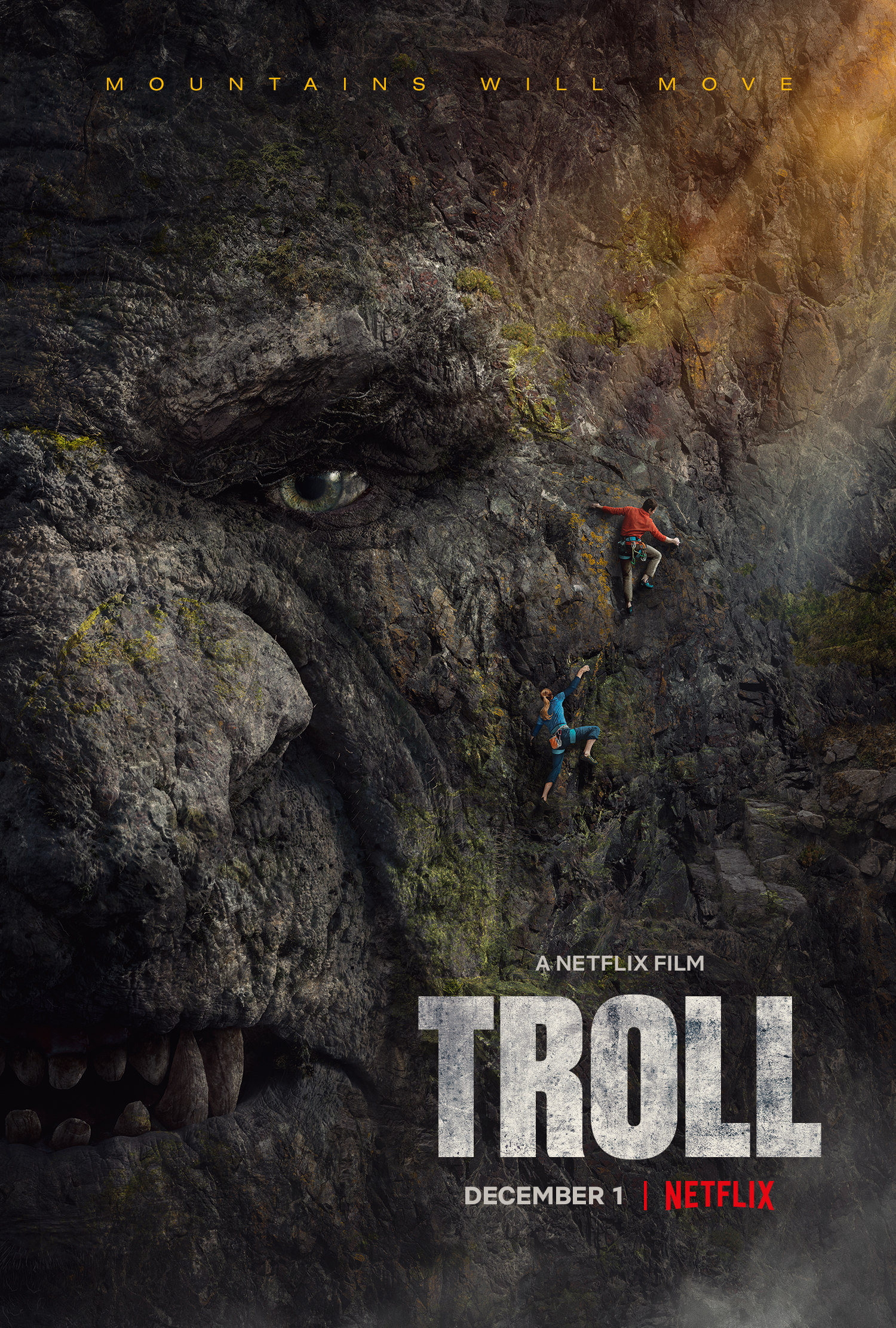
This was so fun! No, it has no relation to the 80’s movie. This is a Norwegian Godzilla. And it’s really good, you should watch it. If there is a sequel, they’ll have to call it… Troll 2. But I bet it gets a subtitle.
Showing posts with label movies. Show all posts
Wednesday, December 14, 2022
Wednesday, January 3, 2018
Modern Times
Here's another Chaplin film that everyone knows from the iconic gear scene, but I think very few people have seen all the way through. I really think of it as Chaplin's masterpiece. It presents itself as a silent film, but it isn't, really -- it has a recorded soundtrack, which includes talking -- however, it largely follows a creepy rule: In Modern Times, only machines are allowed to talk. The effects and editing are incredible, and the film keeps moving, vigorously, from scene to scene. I never thought about it, but the passion for creating 8-bit games at this point in time is a lot like Chaplin continuing to make silent films into the late thirties. The message of the film is fascinating -- when men behave like machines they are degraded, but when they behave like humans, they are the most elevated, and the most successful. The film doesn't rub your nose in this, but sneaks up on it, and implies it, with tricky things like Chaplin's famous nonsense song at the end -- it's such a human situation, a human solution to a very human problem. This film will stay relevant until we truly understand, embrace, and protect what it means to be human, and we have a long way to go before we get there.
Also: Yeah, Criterion Collection.
Tuesday, January 2, 2018
It Happened One Night
This is one of those movies that I've heard about my whole life, largely made reference to by innumerable sitcoms where a new couple has to share a bedroom unexpectedly. The actresses in those shows always seemed to take on such an almost reverent attitude about the film, as if there was something in the romantic story that they aspired to in their real lives. But I can't say I've ever heard anyone in real life talk about the film that way. It is a very corny idea for a story -- heiress flees fiancee, and gets help dealing with harsh reality by a down-on-his-luck reporter, and they fall in love along the way. It's mostly a movie about moments -- the hitchhiking scene, the singing on the bus scene, and of course the "walls of Jericho" scene. And there is an undoubted chemistry between Colbert and Cooper. Frank Capra doesn't do a lot of love stories, so this one stands out compared to his other films. And there are so many fascinating stories around this film. Apparently Colbert wasn't interested in doing it, and they made the film incredibly fast (4 weeks) so they could meet her expensive weekly rate. It is based on a short story called Night Bus (that I would like to read sometime) that Capra apparently read in a magazine in a waiting room, and thought it would make a good film. After it was made, Colbert is said to have told her friends that she just made the worst picture of her career. It must have been quite a surprise, then, when the film won five Oscars, including Best Actress. Everything was working against this film, but there is something magical in it. I think it centers on the father character - the film does something very clever here, making a kind of straw man villain, and then taking that villain away, creating a sudden shift from external opposition to internal opposition, creating a "cave" situation where the protagonists must each transform for the story to resolve. It really is a sort of a rabbit out of a hat -- if you know a story that has the same structure as this one, I'd love to know about it.
And speaking of rabbits, apparently Bugs Bunny's carrot eating was inspired by the carrot scenes between Cooper and Colbert in this film. I guess it shows that when we make things, one never knows what effect they might one day have.
Sunday, September 13, 2015
It's Kind of a Funny Story
Roger Ebert once suggested that "little boxes" on the movie poster with pictures of the cast members was usually a sign of a bad movie, but this must be the exception that proves the rule. It's a simple, clever, and charming story about a stressed out teen who checks himself into a psych ward and gets a dose of the realities of mental illness. It has some great performances in it, with Zach Galafianakis mostly stealing the show. Lots of other familiar actors and comedians are in it as well -- Jim Gaffigan, Aasif Mandvi, and Jeremy Davies (Dr. Faraday from Lost), for example. In short, it is fun, touching, a pleasing 13+ family film that has me curious to read the book.
Sunday, August 23, 2015
Back to the Future
In our attempt to properly educate our daughter about the
foundations of nerd culture, Back to the Future seemed pretty necessary. And it
worked to good effect – she stayed interested, and appreciated the jokes. One
thing that had not sunk in with me about the movie – how much it keeps moving!
It barely stops for a moment, and tries to tell a slightly complicated story,
almost never stopping to recap, which makes it an impressive piece of
storytelling. When I advise my students to create “impossible”
situations for their characters (novice storytellers never want to create these
situations because they can’t see a way out), I think I’ll show the five
minutes leading up to the climax, where it seems like there is no conceivable
way for Doc Brown to get everything hooked up properly.
One thing that really startled me – I watched the “deleted
scenes” – had those been included, it would have been a very different movie!
In them, Doc Brown is lecherous and foul-mouthed, the neighborhood cop takes a
bribe, and Marty’s Mom cheats on a test for no obvious dramatic reason. They
were wise to cut all that, it would have made the film seem grubby. Although, I
always had wondered how Doc Brown got rid of the cop… now I wish I didn’t know!
Sunday, August 9, 2015
Minions
I went into this film with really low expectations. Sure, I enjoyed Despicable Me, and I heard the sequel was okay, but the minions, though mildly amusing, were hardly my favorite part of the film. And when I heard that a film featuring the minions was planned, it just sounded like a kind of sell-out idea. How could they possibly carry a feature film? They only speak a kind of gibberish, and their individual identity is very limited. On top of that, they are helpers to a villain, so there is a challenge getting the audience to empathize with them. I can understand some amusing shorts featuring them, but a Hollywood film would require a kind of hero’s journey, and that just seemed kind of ludicrous.
Well, wow, was I wrong. This film is something of a magic trick, achieved through bravery and cleverness. The keys to success, as best I can pick them out:
- An incredibly strange premise: The minions have always lived on earth, parallel with dinosaurs and the evolution of man. They seem to be immortal, or at least living hundreds of millions of years. Where they came from is left a mystery.
- The minions seek out the biggest, most evil entity they can find, and endeavor to help it. It isn’t clear why they do this – it’s just what they do.
- It isn’t explicitly mentioned, but it is clear that the minions, in the traditional way of clowns and fools, bring bad luck to those around them, but are always lucky themselves in the long run. Weirdly, since they are attracted to villains, this makes them an unwitting force for good.
- In the story, the minions simply run out of villains, and become quite bored and dismal. Accordingly, three of them set out on a journey to find a new villain. This simple move allows for a hero’s journey to happen.
- We then are confronted with the strange world of the villains, and a story happens. The storytellers are completely unconcerned with reality – this is very important – as some very improbable things happen – Minion Bob becomes the King of England, for example, and somehow the story world doesn’t break – it just keeps stretching, like taffy, because everything just happens so fast, and is so funny, that it doesn’t much matter that what’s happening is impossible. It’s like a funny uncle telling an absurd story to six year olds at a birthday party. They keep laughing, so he keeps making the story more absurd, and they laugh all the more.
- Amazingly, there is never some weird misunderstanding separating the minions (see The Muppet Movie, The Three Stooges Movie, etc.), leading to some powerful moment of reconciliation. The minions also do not befriend some cute little girl who has to hide them in her bedroom closet. All the tropes I would have expected just aren’t here. And somehow, the whole thing works… I can’t exactly say why. I guess because the goal of the minions is always very clear, but very challenging, and when things go wrong, we’re pleased to see it. I keep thinking of a story structure I know that’s like this one. Some Marx Brothers movies, say, Horse Feathers, bear some resemblance – but the problem there is that the clowns are helping someone we care about. Typically, in those stories, the clowning makes things worse, and then a stroke of luck + more clowning saves the day. In the beginning it makes the clowns seem insensitive – we feel bad that their clowning is making things hard for the princess. And in the end it often feels like a cop out – they only helped the princess because they were lucky. But here it is all backwards – they don’t realize they aren’t helping the villain, and we don’t mind, because, well, villain. And in the end, yes, there is a stroke of luck + clowning, but it only serves to finally defeat the villain.
- Oh, hey, I should mention – since this is a prequel, and mostly happens in England, they went for a whole sixties rock and roll thing – which on one level has nothing to do with the minions, so on the surface, it seems like a tacky choice. But it is so well executed and fun, that it adds a nice dimension to the film.
- So, finally, the thing I should really call out is the cyclic nature of the minion’s backstory. They necessarily repeatedly go through the cycle of finding a villain, trying to help, and ultimately destroying the villain. This not only opens them up as a long term franchise, it does a lot to strengthen their story relationship with Gru, from Despicable Me. We now see the minions for what they are – a curse that seeks out and destroys whatever villians it comes into contact with, which makes us wonder how they will inevitably bring down Gru, who we have developed empathy for. So, ultimately, the film fosters interest in another sequel.
Monday, July 20, 2015
Duck Soup
In a conversation with my daughter not too long ago, I made the terrifying realization that not only had she never seen a Marx Brothers movie, she actually HAD NO IDEA WHO THE MARX BROTHERS WERE! I mean, no idea. Never heard of Groucho. Glasses, moustache, cigar, it all meant nothing to her. "Do you mean like Karl Marx?" she asked, in all seriousness. "That tears it," I told her, "you've had too much schooling, and not enough fooling!" Comedy is something we take seriously in the Schell household, so we all agreed that something must be done. But which movie to start with? The Cocoanuts, though first, is a bit slow. Some others have seemingly unnecessary padding or serious songs that might bore a modern teenager. But, of course! Duck Soup! It has none of these things. It was the film that made me fall in love with the Marx Brothers (I think I was maybe four? I think I called Groucho "Firefly" until I was six. A man named Firefly was enough to win me over, but the antics of Rufus T. Firefly were irresistible). It is very short (70 minutes), and is certainly the most boiled down of all Marx Brothers films. Many of the others have a "serious story" with relatable characters that the brothers crash into. Duck Soup doesn't bother. It has tiny base story, where all the characters are already simple caricatures, and Marx Brothers dominate the film. It never stops moving, and just when you think it might start making sense, it takes a turn and obstinately refuses to hold to any logical structure. It is the last of the five Paramount Marx Brothers films, and the bravery and daring that can come with being very comfortable with what you are doing really comes through here. I'll go so far as to say that this film captures the essence of the Marx Brothers better than any other. What is that essence exactly? That's a long conversation. They simply aren't like any other comedic structure I know of. The balance of Groucho, Chico, and Harpo simply shouldn't work -- but somehow it does, and there it is. I would have to think very hard to understand exactly how it works. I know part of the key is that Groucho and Harpo almost never interact... but again, I would have to do a lot more thinking to begin to comprehend it. I know of no modern analogue (not any ancient analogue!) for their comedic balance.
So... how did it go over? She laughed so hard it gave her hiccups. Can you imagine creating something so funny that eighty years later, after everyone involved has died, people are still laughing at it uncontrollably? She always respects good comedy, and I was quite proud to see how thoroughly she appreciated the film. Her main reaction was astonishment that the characters were so amazing, and so insanely funny. I continue to be astonished myself.
Friday, July 17, 2015
Travelling Salesman
My kindle stick noticed I like nerd movies, so it recommended this one. It's a simple idea -- four mathematicians hired by the government solve P vs. NP thus potentially defeating all known computer security. The movie is mostly a circular argument about whether it is ethical for one government to keep this secret. In an attempt to create interest, much of it is filmed in shaky-cam (yecch), and it includes a gratuitous dream sequence. Anyway, I watched Pi (in the theater, even), so why wouldn't I watch this. It was corny and silly and unrealistic, but there was at least a little math in it. Would have been better with more math. Or more action. Or both. Still -- any movie that mentions Hardy is alright by me. They should have used this song in the credits, though.
Saturday, July 11, 2015
The Great Dictator
This is one of those movies that everyone knows about, but I suspect very few people have actually seen it. Have you? No, really, not just the globe sequence, but the whole movie? Well, anyway, I hadn't. I remember buying a clearance copy at Blockbuster Video in 1987, only to find that it only had 15 minutes of footage, and I never followed up until now. It happened to be on TCM one night, and our daughter studied WWII in school this year, so I recorded it for us to watch. I was quite surprised at how dark and frank it was -- I had no idea it would be so direct about abuses against the Jews in the ghettos. It was quite a bold accomplishment, to produce this film in 1940, make it so direct, and also make it so funny and so inspiring. It isn't perfect -- as Chaplin's first speaking role, there is some awkwardness -- he sometimes moves in a pantomime way that seems bizarre in a talking picture. I understand the state department wasn't very happy about the film - they believed it would only serve to move the world further away from peace. Chaplin later said that he if he had known the true extent of the Nazi atrocities, he would not have made the film, which all leads to deep questions about the power and the responsibility of the jester in society. I've often wondered if Jon Stewart has stayed away from certain topics, concerned that he might make certain situations worse.
It is a unique film in many respects, and while I enjoyed it much more than I expected, I very much hope that no one ever has need to make a film like this again.
Monday, July 6, 2015
Now and Forever
I like Gary Cooper, Shirley Temple, and con artist movies, so... yeah, I was pretty much going to like this 1934 film. It always scares me what a good actor Shirley Temple was, even at age six. Guy Standing as Uncle Felix is also pretty great. It isn't a world changing movie, but it has its moments -- honor bright.
Friday, June 26, 2015
The Trial
I had no idea this existed, and then I tripped over it on TCM one night. It's Orson Welles' interpretation of Franz Kafka's The Trial, starring Anthony Perkins. I had really enjoyed the haunting quality of the book, so I was quite intrigued to know how Welles would handle it as a film. First: it's gorgeous! The locations and cinematography do a beautiful job of capturing the dreamlike weirdness of the book. Second: Anthony Perkins can act! I only really remembered him from Psycho, and, well, playing a creepy guy always seems to me to be an easier challenge than playing a real person.
The film does have weaknesses. It is quite slavish to the book, probably to its peril. In trying to cram everything in, everyone talks very fast. In the book, we get to hear Joseph K.'s inner monologue to help give us context. In the film, we don't get that, so when we meet the woman dragging the trunk, we aren't given a chance to understand just how strange it is. The whole thing becomes a kind of fast-motion fun house, which is visually engaging, but not as emotionally engaging as it might be.
The part I found most surprising was the ending (spoilers ahead). As slavish as he was, Welles found it necessary to change Kafka's ending! For me, the message of the book was that just by being born into society, one is instantly judged, instantly on trial, instantly doomed. And this fact means that no human being can ever truly have dignity. Kafka's ending drives this point home. But Welles apparently concluded that Joseph K. was surely Jewish, and to create a film that featured a Jew pitilessly humiliated and murdered by the government was in bad taste, so he made a minor change that did not let Joseph K. survive, but let him at least go down fighting. It's a peculiar, almost cartoonish ending, that personally, I thought cheapened the whole thing. Even Welles admitted that he wasn't happy with this solution, but it was the best he could think of to solve his problem. And I suspect this gives us an interesting view into Welles' character. He was definitely a man to whom dignity was central. I suspect that the The Trial was interesting to him since it is a story about man's battle for dignity. But I don't think I buy his story about not wanting to offend the Jews -- WWII was over about 20 years before this film, and when did Welles care about offending anyone? I think that Welles himself could not accept the idea of a man's battle for dignity shown to be impossible and futile, and so he pulled a Kobayashi Maru, at Kafka's expense, and at the expense of the integrity of the film, of the integrity of Welles himself. I believe this captures the essence of the tragic path of Welles' life and career: protecting one's dignity at the expense of one's integrity. One could easily argue this is also the theme of Citizen Kane, and The Third Man -- possibly of all of Welles' work. He once said The Trial was his greatest film. If dignity over integrity is the great theme of his life, then what greater art could he create than actually compromising his own integrity for the sake of not just his own dignity, but the dignity of the everyman?
The film does have weaknesses. It is quite slavish to the book, probably to its peril. In trying to cram everything in, everyone talks very fast. In the book, we get to hear Joseph K.'s inner monologue to help give us context. In the film, we don't get that, so when we meet the woman dragging the trunk, we aren't given a chance to understand just how strange it is. The whole thing becomes a kind of fast-motion fun house, which is visually engaging, but not as emotionally engaging as it might be.
The part I found most surprising was the ending (spoilers ahead). As slavish as he was, Welles found it necessary to change Kafka's ending! For me, the message of the book was that just by being born into society, one is instantly judged, instantly on trial, instantly doomed. And this fact means that no human being can ever truly have dignity. Kafka's ending drives this point home. But Welles apparently concluded that Joseph K. was surely Jewish, and to create a film that featured a Jew pitilessly humiliated and murdered by the government was in bad taste, so he made a minor change that did not let Joseph K. survive, but let him at least go down fighting. It's a peculiar, almost cartoonish ending, that personally, I thought cheapened the whole thing. Even Welles admitted that he wasn't happy with this solution, but it was the best he could think of to solve his problem. And I suspect this gives us an interesting view into Welles' character. He was definitely a man to whom dignity was central. I suspect that the The Trial was interesting to him since it is a story about man's battle for dignity. But I don't think I buy his story about not wanting to offend the Jews -- WWII was over about 20 years before this film, and when did Welles care about offending anyone? I think that Welles himself could not accept the idea of a man's battle for dignity shown to be impossible and futile, and so he pulled a Kobayashi Maru, at Kafka's expense, and at the expense of the integrity of the film, of the integrity of Welles himself. I believe this captures the essence of the tragic path of Welles' life and career: protecting one's dignity at the expense of one's integrity. One could easily argue this is also the theme of Citizen Kane, and The Third Man -- possibly of all of Welles' work. He once said The Trial was his greatest film. If dignity over integrity is the great theme of his life, then what greater art could he create than actually compromising his own integrity for the sake of not just his own dignity, but the dignity of the everyman?
Wednesday, June 24, 2015
Inside Out
Wow... I sure liked this! I'm pretty sure, in fact, that this is my favorite Pixar movie! I always like thinking about the interior of the mind, and this is the most creative visualization of the functioning of the mind I've seen yet! Emotions, imagination, dreams, imaginary friends, brain development, all of it accounted for in a fun, understandable way! This must have been an incredibly challenging project to get right. When I first heard about the film, my heart fell, because it shares a lot in common with my great unfinished game Ordinary, which is a puzzle game based on six emotions (fear, love, joy, sadness, anger, and confidence) used to drive a choose your own adventure romance story (also the first Schell Games patent!). But watching Inside Out, it's a different enough concept that I have no worries about overlap.
Really, I liked everything about this -- the concept, the writing, the voice acting (best acting Amy Poehler's ever done, I think!), even the weird rendering shader that makes the emotions look kind of like muppets. Unlike Tomorrowland, it had a solid grasp on the hero's journey, and also made the most of Pixar's famous rule-based storytelling... (I *love* rule-based storytelling... so many delicious rules...) I'm so glad they made this! You go, Pixar!
Friday, June 5, 2015
Wreck-it Ralph
I saw this when it first came out in the theater, but we just watched it again at home. I was struck by how different it was at home. So many of the scenes are large and full of tiny detail that was hard to make out on the small screen. It was really a movie made to immerse. I really liked all the classic videogame jokes, that was certainly fun, but what I liked most of all was the depth of the story rules. I always enjoy fantasy worlds that are based on deep rules, and this movie has so many, so interestingly intertwined. Let me see if I can enumerate them...
- Game characters should abide by their programming.
- Game characters are free to move about after the arcade is closed.
- If a character dies outside their game, they die permanently.
- Some characters can suffer from "glitches."
- Characters with glitches cannot ever leave their game.
- Bugs in Hero's Duty are drawn to the beacon.
- It is possible to access and manipulate game code.
...and on and on. I think if I worked at it, I would probably find about 25 or so of these. It makes sense that a story about game characters would be rife with rules.
What I didn't like: so many characters were mean, angry, and rude. Ironically, the least angry character was Q*Bert. I don't think it was necessary to have absolutely every character be so angry and mean so much of the time... it was kind of off-putting.
Anyway -- it certainly made me pine for the old arcade days, and I really was pleased to see such a solid and surprising rule-based storyline. I very much believe that if you want your story to seem real, it must be real to you. It certainly was real to the writers!
Monday, June 1, 2015
Tomorrowland
Gah! Such complicated feels about this movie! Let me see if I can try to unravel it all. (Spoilers ahead.) Tomorrowland made me feel...
Delight. Some of the scenes of "Utopia Tomorrowland" are EXACTLY out of dreams I have had. I believe in my dream diary somewhere I have sketches of the view of the anti-grav swimming pools as seen from inside a glass tube habitrail/monorail system. The main difference being that my tubes also went underwater. Maybe I should say this made me feel creeped out at how identical it was to my dreams, but really, I was too overwhelmed with delight.
Pain. Oh, good lord, those early scenes where young Frank Walker is having his inventions derided because they (a) don't work and (b) are more fun than practical are all things that actually happened to me when I was his age, almost word for word.
Validation. Yes, yes, yes! This is EXACTLY how I see the world! Making things better for everyone is the reason we are here! Why can't everyone understand that? This belief is the reason I do this, and this, and why I made this, and this, and this, and well, just about everything!
Boredom. I think the biggest flaw of the film is that it spends a lot of time being mysterious and vague about what is actually happening. As a result, it was hard to emotionally care about the action. Sure, if the robots destroy the little girl, that would be bad... but, uh, what are the larger consequences? As viewers, we have no idea. I could feel this boredom from the whole audience. We all wanted to care, and we all cared in theory... but I don't think anyone was feeling edge-of-their-seat thrills due to so much vagueness.
Sorrow. Athena's sacrifice was hard for me to take. Not only does she look a great deal like my fifth-grade first crush, but her attitude and mission were that of Peggy Van Pelt, who carried the culture of Imagineering in her own two hands for years until she, too, had to leave us unexpectedly.
Hope. Okay, sure. There's a lot this movie does wrong in terms of entertaining an audience. But if I had seen this when I was twelve -- it could easily have made an major difference in my life. It may not be a box office blockbuster, but if it affects just a few dozen of the right young people the right way, it may have a legacy that is well worth the trouble it took to make this film.
And there is so much more... the scene at the end with the kids looked to be taken straight from The Blue Bird, which implies a lot... the amazing Eiffel Tower scene, which I should have loved, but left me flat... George Clooney not having any real chemistry with the rest of the cast because, well, he is George Clooney.... though for the life of me, I have no suggestions for a better choice... all the connections to The Rational Optimist, the book that has given me more hope than any other for the fate of the human race, but I don't talk about it much, because I am pretty sure that our unrealistic pessimism is the engine that causes humanity to continuously improve.... God, this is all so complicated... this movie puts its finger on the center of a web of incredibly complex, unspoken, important ideas, but it does so clumsily... I really wish this film was better... but I'm not sure I see how to make it better. The road to Hell is paved with good intentions, but so, of course, is the road to Utopia. Thanks, Brad Bird and friends, for getting us one step closer.
Postscript: I’ve continued to think about this movie a lot. At first I wasn’t sure why. But as time went on it became clear to me. This isn’t just a movie to me, it is my religion, and when your religion is portrayed on screen, you want it to be done right. Here’s a brief stab at the tenets of said religion:
But that makes it sound like pessimism and optimism are static, when we know perfectly well they are dynamic: they change with age. Young people are naturally optimistic, old people are naturally pessimistic. And this is the story of Tomorrowland. A young boy who was once optimistic has been ground down into a cranky old pessimist by a cold, hard world. He meets a young girl who is an optimist, and he regains hope. It sounds like a reasonable story, so why is it such a mess? I have some new insights on that after thinking about it for a while.
1) The film fails to follow the Hero’s Journey. I’m not saying every movie should follow the hero’s journey, but when you are telling a story about an underdog saving the world, you should at least consider it. Several important elements of the journey are missing. “The call” is obviously there. But where is “the refusal”? Where is the “point of no return”? What part of the story is “the cave” exactly? Looking at the movie through this lens, these important scenes feel vague and mushy, not crisp and clear, and that vagueness does little to draw us into the story. Also confusing is the fact that the film is trying to relate two parallel stories, which leads to the next question…
2) Who is the protagonist? At first, it seems obvious that Casey is the protagonist. But is she? She behaves in no way like a hero, and undergoes no changes in the story. She is a frustrated optimist in the beginning, middle, and end of the story. She supposedly can “fix anything”, but she is given no opportunity to do so at any point during the story. She is used more as a “key” than anything else. So – it could be George Clooney? There is an argument for this, since he is the one who undergoes the transformation. Looking at the lens of the Hero’s Journey again, he fits the bill a little better… But not a lot better. A colleague of mine suggested that Athena is really the protagonist – which I think might actually be true! She’s the only one who actually knows what is going on, she takes the most risks, and makes the greatest sacrifice. But we never get to see things from her point of view. Which leads us to possibly the greatest problem with the movie…
3) No one knows what is going on. Not our “heroes”, and not the audience. The film spends so much time trying to keep us in the dark, that we can’t really get attached to the plot or the characters. Villains appear – they are obstacles to our heroes… but obstacles to what exactly? What is their motivation? What are the consequences if the villains win? We don’t know, and so how can we care?
Anyway, sighs and sadness. I am writing this on a return flight from Walt Disney World. I felt sure that I would pick up an enamel Tomorrowland pin while I was there. Unfortunately, the film seems to have made so little impact that Disney didn’t even bother to make or sell them. In some ways, the whole Tomorrowland experience feels like validation of the film’s warning – that most people would prefer to let the world go to ruin. But at the same time, I can’t help but notice the meta-theming: if this movie was inspiring to everyone, it wouldn’t be a call to the select few who actually want to improve things. I can’t help but think that somehow, quietly, this film will end up being a signifier that those of my religion will use to find one another. That's why the pins aren't available to everyone at Disney World. After all – for reasons I have never understood, sloppy storytelling is a shared feature of all sacred texts.
Postscript: I’ve continued to think about this movie a lot. At first I wasn’t sure why. But as time went on it became clear to me. This isn’t just a movie to me, it is my religion, and when your religion is portrayed on screen, you want it to be done right. Here’s a brief stab at the tenets of said religion:
- The universe wants us to help each other.
- The human race is on a journey that is taking us ever closer to utopia.
- We must work hard and use what gifts we have to make the world a wonderful place.
But that makes it sound like pessimism and optimism are static, when we know perfectly well they are dynamic: they change with age. Young people are naturally optimistic, old people are naturally pessimistic. And this is the story of Tomorrowland. A young boy who was once optimistic has been ground down into a cranky old pessimist by a cold, hard world. He meets a young girl who is an optimist, and he regains hope. It sounds like a reasonable story, so why is it such a mess? I have some new insights on that after thinking about it for a while.
1) The film fails to follow the Hero’s Journey. I’m not saying every movie should follow the hero’s journey, but when you are telling a story about an underdog saving the world, you should at least consider it. Several important elements of the journey are missing. “The call” is obviously there. But where is “the refusal”? Where is the “point of no return”? What part of the story is “the cave” exactly? Looking at the movie through this lens, these important scenes feel vague and mushy, not crisp and clear, and that vagueness does little to draw us into the story. Also confusing is the fact that the film is trying to relate two parallel stories, which leads to the next question…
2) Who is the protagonist? At first, it seems obvious that Casey is the protagonist. But is she? She behaves in no way like a hero, and undergoes no changes in the story. She is a frustrated optimist in the beginning, middle, and end of the story. She supposedly can “fix anything”, but she is given no opportunity to do so at any point during the story. She is used more as a “key” than anything else. So – it could be George Clooney? There is an argument for this, since he is the one who undergoes the transformation. Looking at the lens of the Hero’s Journey again, he fits the bill a little better… But not a lot better. A colleague of mine suggested that Athena is really the protagonist – which I think might actually be true! She’s the only one who actually knows what is going on, she takes the most risks, and makes the greatest sacrifice. But we never get to see things from her point of view. Which leads us to possibly the greatest problem with the movie…
3) No one knows what is going on. Not our “heroes”, and not the audience. The film spends so much time trying to keep us in the dark, that we can’t really get attached to the plot or the characters. Villains appear – they are obstacles to our heroes… but obstacles to what exactly? What is their motivation? What are the consequences if the villains win? We don’t know, and so how can we care?
Anyway, sighs and sadness. I am writing this on a return flight from Walt Disney World. I felt sure that I would pick up an enamel Tomorrowland pin while I was there. Unfortunately, the film seems to have made so little impact that Disney didn’t even bother to make or sell them. In some ways, the whole Tomorrowland experience feels like validation of the film’s warning – that most people would prefer to let the world go to ruin. But at the same time, I can’t help but notice the meta-theming: if this movie was inspiring to everyone, it wouldn’t be a call to the select few who actually want to improve things. I can’t help but think that somehow, quietly, this film will end up being a signifier that those of my religion will use to find one another. That's why the pins aren't available to everyone at Disney World. After all – for reasons I have never understood, sloppy storytelling is a shared feature of all sacred texts.
Monday, May 25, 2015
Princess Kaguya
I really enjoyed this. For starters, it is beautiful, with something of a watercolor look. It takes its time, which is nice, as well. It is surreal in the Studio Ghibli tradition, with characters that are charming and interesting. The moral, simply put (spoilers) is this: When the Gods send you a child, listen to what she says. All parents might do well to contemplate this.
Thursday, May 7, 2015
Duel
I've had the DVD of Duel sitting around forever, but I never got around to watching it until just recently. I was home sick, and it seemed like a good sick day movie -- and it was! I thought it would be good, but I had no idea it would be as good as it is. So weird, so elegant, so stylish. When I watched the DVD extras (definitely worth the price of the DVD), I understood why! It was written by Richard Matheson, writer for Twilight Zone, not to mention the screenplay for The Incredible Shrinking Man, and then it had a young Steven Spielberg trying to prove himself. Unbelievably, it was shot in 12 days (the budget was for 10), as they only had budget for an ABC Movie of the Week. It was originally something like 71 minutes, but footage was added for international theatrical release. You can see so much of Jaws in this movie. Even the music is interesting and clever. Spielberg notes that he chose Dennis Weaver as the star because he loved his role in Touch of Evil. This is just one of those times when the right artists get together and make something greater than all of them. My only nitpick would be that the internal monologues come off a little corny, but really, I'm not sure how you'd tell the story without them. I love the underlying masculinity theme that flirts around the edges of everything. Anyway, put great people under pressure, and sometimes great things happen. I would like, one day, to make something so elegant and powerful.
Saturday, April 25, 2015
Frozen
I know I'm late writing about this, but I thought I would finally get around to it. It's fascinating that this movie is as popular as it is. I'm not sure I understand why, exactly. The fantasy of ice magic is fun, and there are a lot of exciting and funny moments, and then on top of that it has a very interesting message. It doesn't exactly follow the mold of a normal fairy tale, but then again, it does. What I find most interesting is that everyone I talk to seems to have a different way of expressing what the movie is really about. So, here's my take on the theme of the film: We all have terrible things inside us. Repressing them is ultimately impossible. Letting them out, especially after they are bottled up, leads to disaster. However, tempering them with love can be peaceful, beautiful, and powerful. An unusual message for a fairy tale! That's my interpretation, anyway. It's a sign of a powerful story that many people find many different meanings in it. Oh, and Josh Gad was really funny, and Kristen Bell's performance was excellent and overlooked.
Saturday, April 18, 2015
The Banshee Chapter
I got to see this film in McConomy Auditorium at CMU as part of Spring Carnival, and afterwards I had the privilege of hosting a Q&A session with the director (Blair Erickson) and producer (Corey Moosa). It's a fun horror movie with a lot of jump-scare moments, very much inspired by the 1986 horror film From Beyond which is based on the H.P. Lovecraft story of the same name. I like any movie that mentions the pineal gland, and I'm always fascinated by films of Lovecraft stories. The film brings the pineal gland up to date by having it activated not by a electronic tuning fork, but rather by a variant on the psychotropic drug DMT. Interestingly, this film will have a place in history, as it is one of the first films converted to VR. It is available on Mac for the Oculus Rift. I haven't tried that, but I understand that the scary moments are very scary, but the handheld camera scenes can be a little hard to take, "motion discomfort"-wise. Talking to Blair and his team, they are pursuing the dream of VR movies -- I was quite pleased to learn that they had taken Building Virtual Worlds with Randy Pausch back in its early days -- they were surprised to learn that I teach it now! It will be quite interesting to see what they come up with next.
Monday, April 6, 2015
Song of the Sea
Do you like selkies? Magic? Celtic stuff? Beautiful animation? Then you'll probably want to check out Song of the Sea. It is hard not to stare in amazement the whole film at how beautiful everything is. It's a great story for kids, but it is also mysterious and dark enough to be interesting to adults. We live in an amazing age when a an animated film this wonderful doesn't really get noticed because the world is already full of beautiful things. But seriously, don't go see "Home" or whatever this week's farting alien movie is... watch this instead.
Sunday, April 5, 2015
One Man's Way
This is a 1960's biopic about Norman Vincent Peale. It stars Don Murray as Peale, and he does a great job as a movie screen minister. I'm always interested in stories about charismatic speakers who are trying to balance showmanship and meaning -- and this is certainly one of those. I can't say I found it hugely inspiring, but it certainly asks some good questions, and it makes me wonder about maybe finally getting around to reading The Power of Positive Thinking. Also, look for Gerald Gordon (aka Nick Bellini from "The Doctors" ... I'm hooked on that right now), and Ann Morgan Guilbert (Millie from the Dick van Dyke show). How, exactly, faith should best be a part of our lives is something each of us has the pleasure and privilege to wrestle with.
Subscribe to:
Posts (Atom)


